
When one seed disagrees with six: a reality check on the resource-buffer comparison
A week ago I posted
Does the resource buffer pick the genes?,
a three-way comparison of intrinsic-evolution runs at conservative, balanced,
and buffered resource levels. It made three concrete claims off a single
seed: the speciation trajectory direction flipped with the buffer
(merging under conservative, V-shaped under balanced, diverging under
buffered), learning_rate flipped sign with the buffer (negative at low
food, positive at high food), and ensemble_size did the same.
I then re-ran the comparison with 6 seeds per profile — 18 runs total — to see which of those numbers were the experiment talking and which were the seed talking. The answer is mostly: the seed was talking. Most of the flip claims do not survive replication. One qualitative pattern survives strongly, and a few magnitude trends survive weakly. This post is the walk-through, and the methods lesson is at the end.
Setup
Three sub-profiles of the stable initial-conditions preset
(conservative, balanced, buffered), 6 seeds each
([42, 7, 19, 101, 137, 256]), 1000 logged steps after a 200-step warmup.
Everything else is held the same as the
05-04 comparison:
30 founders seeded by independent mutation, mutation rate 0.15 / scale
0.10, crossover off, GMM speciation tracking, selection_pressure="low".
Runner: scripts/run_stable_profile_seed_sweep.py.
Analyzer: scripts/analyze_stable_profile_seed_sweep.py.
Aggregated outputs: experiments/stable_profile_sweep/aggregate/.
What survived
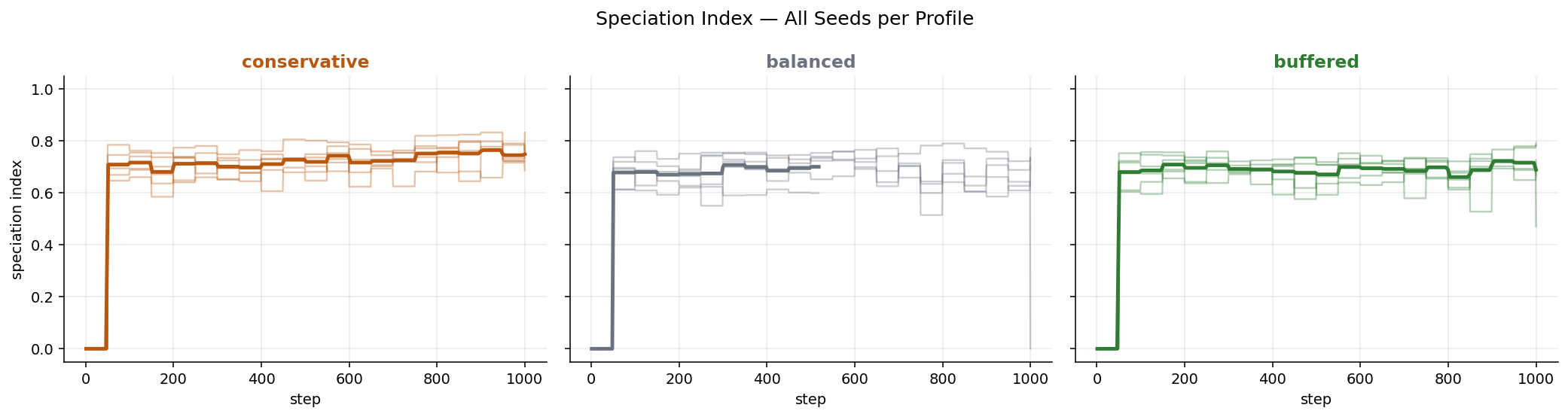
Speciation always diverges. All 18 runs come out classified as
diverging (positive slope on the speciation index over time), and the
direction agreement is 1.00 within every profile. That is the strongest
single result in the sweep.
| Profile | Mean final speciation | 95% CI | Slope / 100 steps |
|---|---|---|---|
| conservative | 0.748 | [0.697, 0.800] | 0.0258 |
| balanced | 0.590 | [0.280, 0.899] | 0.0239 |
| buffered | 0.689 | [0.565, 0.812] | 0.0200 |
Population scales monotonically with the buffer, as expected: conservative 84 / balanced 96 / buffered 108 mean. The resource knob is doing what it should do at the ecological level.
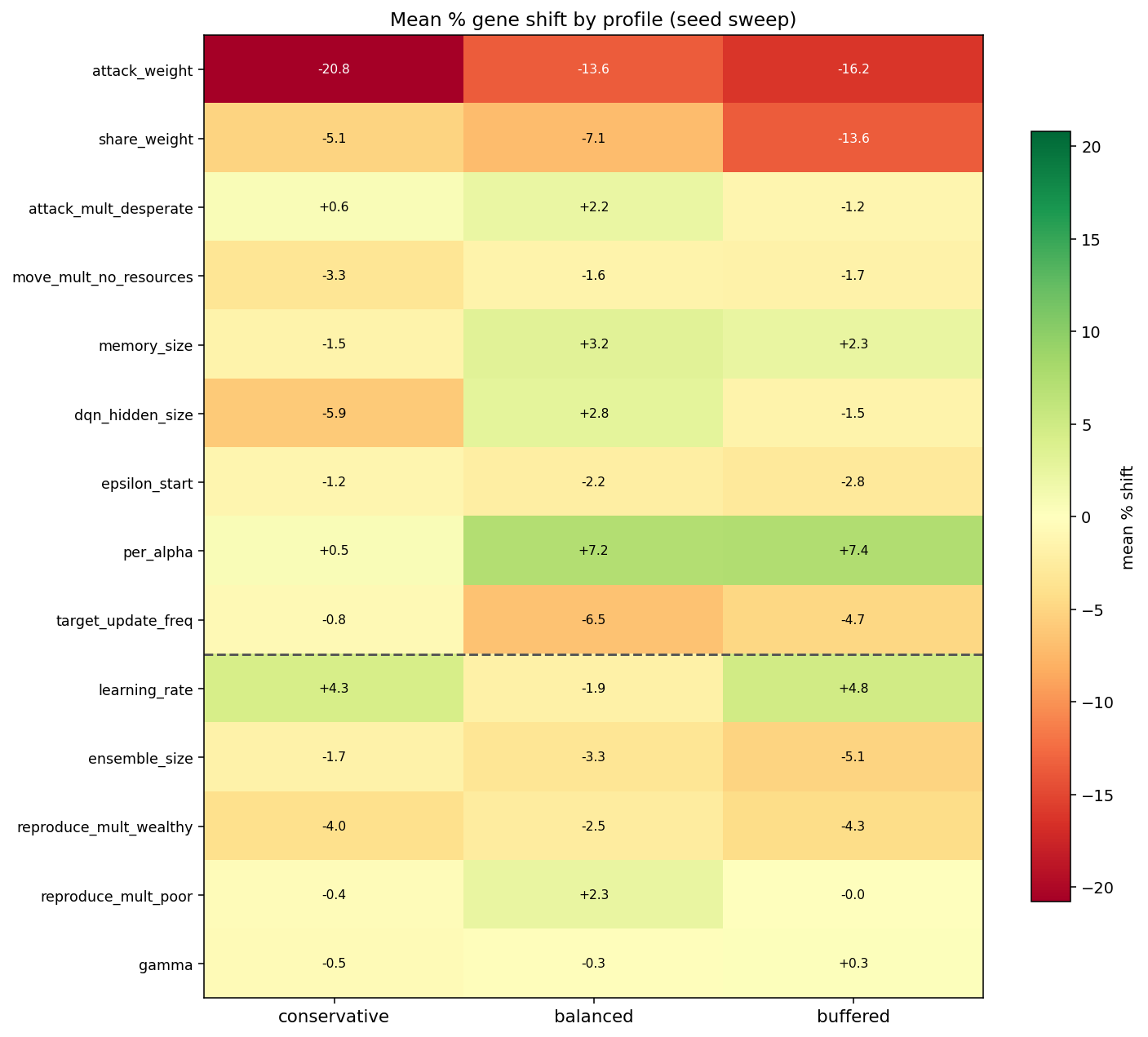
A handful of per-gene shifts have consistent sign across all three profiles, even though the strict ≥75% within-profile sign-agreement test calls every gene “seed-sensitive”. The most striking ones:
| Gene | conservative | balanced | buffered | Note |
|---|---|---|---|---|
attack_weight |
−20.8% | −13.6% | −16.2% | Negative in every run |
attack_mult_stable |
−17.3% | −17.1% | −17.1% | Remarkably consistent mag. |
share_weight |
−5.1% | −7.1% | −13.6% | Negative; gradient by buf. |
per_alpha |
+0.5% | +7.2% | +7.4% | Positive everywhere |
epsilon_start |
−1.2% | −2.2% | −2.8% | Small, monotonic |
The robust qualitative story from the original post — “agents drift away from aggression and altruism, toward more stable learning” — still holds at the population-mean level. What does not hold is the buffer flipping any of these directions.
What didn’t survive
The speciation-trajectory split. The 05-04 post had
conservative → merging, balanced → V-shape, buffered → diverging.
With six seeds per profile that split disappears: every profile’s modal
direction is diverging, and the per-profile slopes are all positive
and within a factor of ~1.3 of each other.
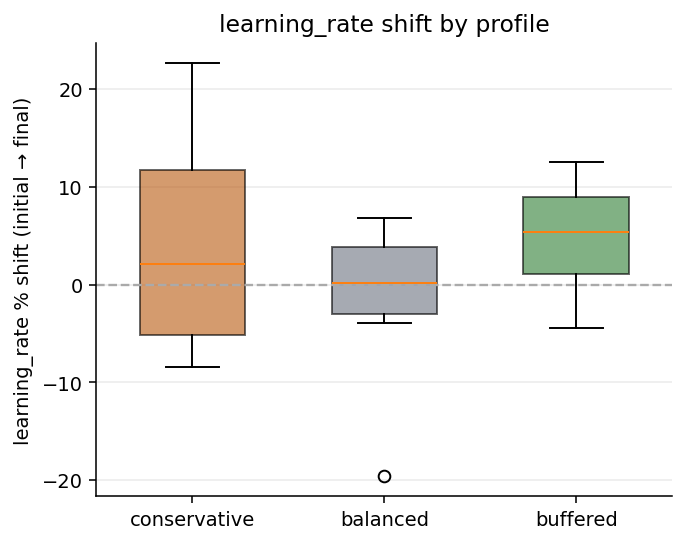
The learning_rate flip. This was the headline gene-level claim of
the original post. The single-seed run had:
| Profile | learning_rate shift (single seed, 05-04) |
|---|---|
| conservative | −8.3% |
| balanced | −6.0% |
| buffered | +23.1% |
The six-seed sweep gives:
| Profile | Mean % shift | 95% CI | Sign agreement |
|---|---|---|---|
| conservative | +4.3 | [−8.41, +17.03] | 0.00 |
| balanced | −1.9 | [−11.81, +8.05] | 0.00 |
| buffered | +4.8 | [−1.79, +11.34] | 0.67 |
Every 95% CI straddles zero. Within each profile the seeds disagree about whether the shift is positive or negative at almost a coin-flip rate. The +23% in the original buffered run is the high tail of a distribution centred near +5%, not a structural property of the regime.
The ensemble_size flip. Original numbers were −25.9 / −8.8 / +2.6.
Six-seed means are −1.7 / −3.3 / −5.1, all with CIs straddling zero
and 0.00 sign agreement on conservative. Direction is roughly
consistent across profiles (slight negative) but with no real flip,
and the −26% single-seed value was an outlier.
The reproduce_mult_wealthy / reproduce_mult_poor flips. Both
collapse into low-magnitude shifts within noise (means ranging from
−4.3% to +2.3%), no robust sign-flip pattern.
The gene-shift heatmap below shows the full picture. Cells that looked clean and oppositely-signed in the single-seed comparison go closer to zero and lose direction once you average over six seeds:
What partially survived
The strict ≥75% within-profile sign-agreement threshold classifies all 31 genes as “seed-sensitive”. That’s harsh and a bit misleading. Several genes show clear and consistent direction across profiles but have a couple of contrarian seeds, which is enough to flunk the strict test:
attack_weight,share_weight: negative mean in every profile, and buffered’sattack_weightCI excludes zero.attack_mult_stable: same mean (~−17%) in all three profiles, with large per-seed variance.per_alpha: positive in every profile, with the lower CI bound above zero for bothbalancedandbuffered.
So “this gene moves the same way regardless of how much food the world has” is a real pattern. “This gene flips direction depending on how much food the world has” largely is not.
A non-obvious twist
The post’s intuition was “more food → more room in chromosome space → higher speciation”. The sweep says the opposite, mildly:
- conservative: 0.748 mean final speciation
- balanced: 0.590
- buffered: 0.689
Conservative is the highest and tightest (CI [0.697, 0.800]),
buffered is moderate, and balanced is both the lowest mean and the
most variable (CI [0.280, 0.899]). The balanced profile sits in
between conservative and buffered in resource level but is not in
between them in outcome variance — it’s a wider distribution than
either neighbour. That asymmetry is worth its own follow-up; my guess
is that “balanced” sits near a tipping point between two failure
modes, but I don’t have evidence yet.
The methods lesson
Which kinds of claims got falsified and which survived divides cleanly:
- Qualitative directional claims that aggregate over many runs (“speciation diverges”, “agents shed aggression”, “population scales with food”) held up.
- Per-locus magnitude claims off a single seed (“
learning_ratedrops 8% under conservative”, “ensemble_sizeis chopped by 26%”) did not. They were the noisy tail of a centred-near-zero distribution. - Direction-flip claims off a single seed (“low food selects against X, high food selects for X”) are the most fragile kind. All four of those from the prior post collapsed.
The rule-of-thumb I’m internalising is: report a direction and a rough magnitude from a single seed, but never report a flip between regimes before running ≥5 seeds at each regime. Flips look like they carry the most signal per word, so they’re the most tempting to write up; but they’re also the easiest to manufacture by accident with one seed at each setting.
The thing the 05-04 post got right structurally is harder to see now: the qualitative behavioural shift (less aggression, less altruism, more stable learning) was visible in three single-seed runs and survives at six seeds each, which is genuine information. The thing it got wrong was treating between-regime differences in those gene shifts as signal when the within-regime variance across seeds was larger than the between-regime mean differences.
Implications
For this project, the biggest implication is a change in what counts as “enough evidence” for a claim.
- Treat multi-seed agreement as the baseline for directional claims. Especially for “X flips across conditions” statements, assume fragility until replication says otherwise.
- Treat profile effects as distribution shifts, not deterministic signs. In this sweep, the buffer changes means and variances clearly, but not the sign of most gene shifts.
- Keep uncertainty in the headline, not just in appendix tables. Means, CIs, and sign-agreement should travel together in the narrative.
- Prioritise mechanism tests over rerunning old single-seed stories.
The productive next questions are long-horizon behavior, crossover/gene-flow
effects, and why
balancedis a high-variance regime.
In short: publish fewer flip claims, publish more replicated patterns.
What’s next
Revising the four follow-ups at the end of the 05-04 post in light of the sweep:
Update (2026-05-14): Added execution-ready conservative long-horizon command blocks (3k and 5k, multi-seed, on-disk DB) to Issue #867, along with a short runbook for aggregation. A completed balanced 5k long-horizon run is also documented in the same issue as a reference analysis pattern.
- The “small seed sweep per profile” item is now done.
- Longer conservative runs are still worth doing, but the motivation changes. It’s no longer “does the conservative cluster merge?” — it doesn’t, all three profiles diverge. The new question is whether the rising speciation index in conservative continues to climb, or plateaus near the current 0.75. (Issue #867.)
Crossover-on rerun— completed 2026-05-18 (updated crossover code, disk DB). Buffered: gene flow does not knock down the diverging trajectory (6/6 seeds still diverging; no robust final/slope collapse). Conservative: crossover does robustly lower speciation index vs. baseline (bothuniformandblendarms). See Gene flow and the buffer and crossover rerun docs (Issue #845).- Widening the buffer axis to include
stressandlegacyprofiles is still on the list, but should be multi-seed from the start. (Issue #846.)
One new follow-up I’d add: dig into why balanced is the
high-variance profile. The natural prediction was a monotonic
relationship between buffer level and outcome variance; the data
shows a peak in the middle instead.
For the raw aggregate numbers, see
experiments/stable_profile_sweep/aggregate/seed_sweep_summary.md
and seed_sweep_summary.json.