
Gene flow and the buffer: when crossover compresses (and when it doesn't)
The 05-12 seed sweep gave a clean baseline: with crossover off, speciation trajectories diverged across conservative, balanced, and buffered resource profiles. The obvious mechanism question was whether that divergence was mostly an artifact of mutation-only inheritance. If we add gene flow, do clusters collapse?
I re-ran the same 6-seed matrix with crossover enabled and compared each run against its no-crossover counterpart by profile and seed.
Short answer: it depends on the profile. Gene flow robustly compresses endpoint separation in conservative runs (it doesn’t merge clusters — all arms still end clearly above the merging regime), leaves buffered runs essentially unchanged, and stays noisy in balanced runs.
Setup
Two crossover arms, each paired against the existing no-crossover baseline:
uniform: per-gene coin-flip recombinationblend: BLX-alpha interpolation (alpha=0.5)
Shared setup:
- profiles:
conservative,balanced,buffered - seeds:
[42, 7, 19, 101, 137, 256] - logged steps: 1000 (after 200-step warmup)
- selection pressure:
low - speciation tracking: GMM, max k = 4
- database mode: disk-backed SQLite (
--disk-database)
Commands and full artifact paths live in crossover_rerun.md.
The headline result
| Profile | uniform | blend |
|---|---|---|
| conservative | robustly compresses | robustly compresses |
| balanced | no robust effect | no robust effect |
| buffered | no robust effect | no robust effect |
Verdict rule is the same one used in analysis scripts: paired delta on
speciation_final or speciation_slope with 95% CI excluding zero and at
least 75% within-profile sign agreement. The analyzer labels this verdict
“robustly collapses”; I’m calling it “compresses” here because the magnitude
is small (Δ ≈ -0.06 to -0.09) and the trajectories still end well above the
merging regime — see the conservative panel below.
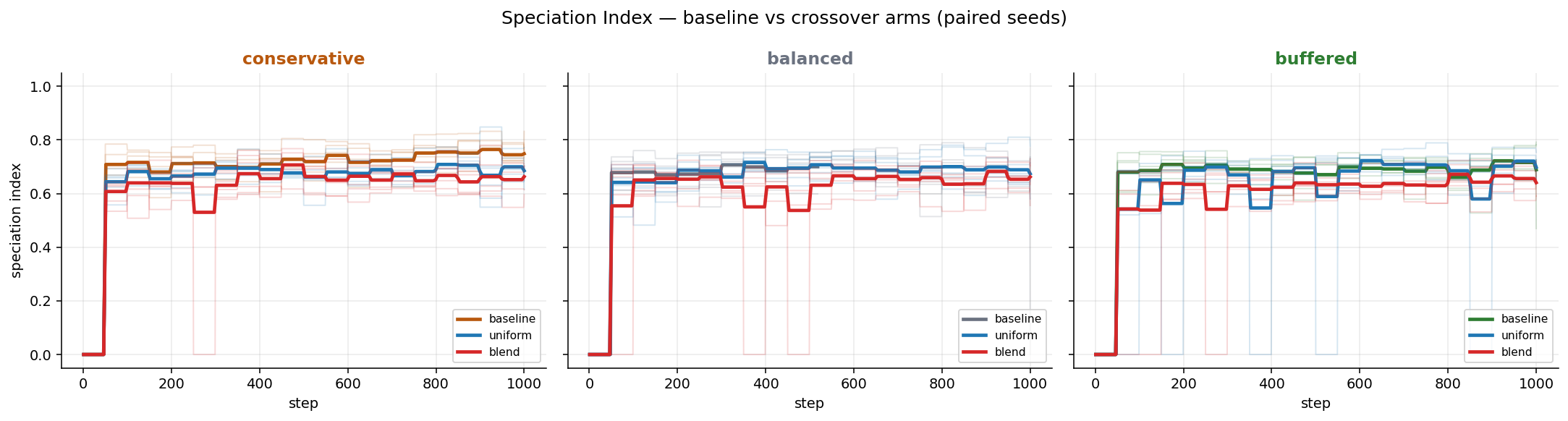
What changes by profile
Conservative: crossover compresses (it does not collapse)
This is the biggest surprise in the rerun. Against no-crossover baseline:
- baseline final speciation:
0.748 uniformfinal:0.685(Δ-0.063, 95% CI excludes zero, 6/6 negative)blendfinal:0.663(Δ-0.086, 95% CI excludes zero, 6/6 negative)
Both arms still classify as diverging (6/6 seeds, positive slope), and all
three arms end well above the merging regime. The chart shows this clearly:
the orange baseline line sits ~0.07-0.09 above the uniform/blend lines, but
all three are rising and stay in the 0.65-0.78 band. So crossover does not
invert trajectory direction and does not pull clusters together; it shifts
the rising trace down by a small, robust amount.
Buffered (#845): trajectory survives gene flow
Issue #845 asked whether gene flow collapses the buffered “rising speciation” pattern.
Across all six seeds, buffered trajectories are still diverging under both
arms. Paired deltas on final speciation are not robustly negative; slope
deltas are slightly positive (uniform +0.007, blend +0.006) but also not
robust.
| Metric | Baseline | uniform | blend |
|---|---|---|---|
| Mean final speciation | 0.689 | 0.698 | 0.641 |
| Mean slope (/100 steps) | 0.020 | 0.027 | 0.026 |
| Direction agreement | diverging (6/6) | diverging (6/6) | diverging (6/6) |
Blend does lower mean speciation over the run, but not enough to qualify as a robust collapse on the final-index or slope criteria.
Balanced: still the high-variance middle
Balanced remains the least stable profile in this line of experiments. Neither arm produces a robust paired shift in final speciation or slope. This matches the earlier “balanced is unusually variable” pattern from 05-12.
What this says about the mechanism
The buffer seems to control how much recombination can pull lineages together:
- under tighter-resource conservative conditions, crossover compresses endpoint separation by a small but robust amount (without merging clusters);
- under buffered conditions, crossover mixes genes but does not erase the diverging trajectory pattern;
- balanced remains near a regime boundary where variance dominates.
So the updated claim is more measured than a “gene flow erases speciation” story: resource profile shapes the strength of crossover’s compressive effect on speciation, but in this regime it modulates rather than reverses the diverging trajectory.
Caveats
- This remains a low-selection-pressure regime (
selection_pressure="low"). - Metrics answer trajectory and endpoint questions, not causality at the behavioral-policy level.
- Several per-gene shifts (including
learning_rate) remain seed-sensitive.
What’s next
- Long-horizon conservative sweeps (Issue #867): does crossover compression persist or saturate over 3k-5k steps?
- Wider profile axis with
stressandlegacy(Issue #846). - Follow-up on why
balancedis the variance peak.