
The inheritance ladder doesn't climb: warm-start clamps offspring reward
The 06-20 transferable-signal gate cleared the precondition for #904: in a learning-positive regime an end-of-life policy really does forage a little better than its own random init, worth ~+15-30 net early reward. That is the prize the inherited-payload ladder is supposed to hand to offspring. This post runs the ladder itself — the full matched A/B across all five inheritance arms — and grades it on the metric the gate validated: net RL reward over an offspring’s first {10, 25, 50} steps of life.
The pilot (balanced profile, 2 seeds) was too underpowered to say anything — huge CIs, seeds disagreeing on sign. The full 90-run sweep is not underpowered, and the answer is sharp and negative: no payload beats Baldwinian cold-start. Every robust early-life effect is a loss, and the richer the payload, the bigger the loss. More importantly, the shape of the failure is diagnostic — warm-start doesn’t merely fail to help, it clamps offspring to a low, ecology-blind reward trajectory.
The regime and what ran
One matched sweep, graded per (profile, seed) against the P0 baseline with the standard project robustness gate (paired 95% CI excludes zero and within-profile sign agreement >= 0.75):
- Arms (5):
baldwinian(P0),lamarckian(P1, weights),p2(plasticity damping),p3(optimizer state + replay slice),p4(fitness-gated θ blend). Default warm-start knobs (damping 0.5, replay limit 256, blend 0.5, gate 1.0). - Population: 8 independent agents,
max_population=32. Unlike the gate, reproduction stays on — inheritance happens at reproduction — so the cap contains the colony instead of the gate’s fixed-8 no-repro setup. - Horizon: 3000 steps, 200-step warmup (offspring scored are born after warmup), snapshot every 100.
- Matrix: 3 profiles (
conservative/balanced/buffered) x 6 seeds (42 7 19 101 137 256) x 5 arms = 90 runs.
Offspring cohorts are healthy — typically 50-160 post-warmup offspring per run reaching age 10 — so this is a genuinely powered comparison, not the n=2 pilot.
Headline result: the ladder is entirely negative
Sixteen (profile, arm, age) cells clear the robustness gate on net early RL reward. All sixteen are negative — offspring do worse than cold-start P0. None are positive. Mean deltas at age 50 (treatment minus baldwinian):
| Profile | lamarckian | p2 | p3 | p4 |
|---|---|---|---|---|
| conservative | -1.5 | -6.6 | -2.4 | -9.5 |
| balanced | -6.8 | -6.1 | -2.8 | -12.0 |
| buffered | -25.3 | -24.1 | -21.2 | -28.4 |
(Bold = robust.) On buffered, every arm loses robustly at every age; on
conservative/balanced, P1-P3 are mostly null-to-negative and P4 is
robustly negative. There is no profile, no age, and no arm where a richer
inherited payload beats the cold-start baseline.
The whole-population readouts (compare_inheritance_arms.py) tell the
complementary story: no robust effect for any arm on any profile for
population mean/final, speciation slope, or startup-transient stability. As in
the 05-21 and 06-04 nulls, the colony-level summaries don’t move; the action is
entirely in early life, and there it is harmful.
The diagnostic: warm-start clamps offspring regardless of ecology
The single most informative view is cumulative reward vs. age, baseline vs. the richest payload (P4):
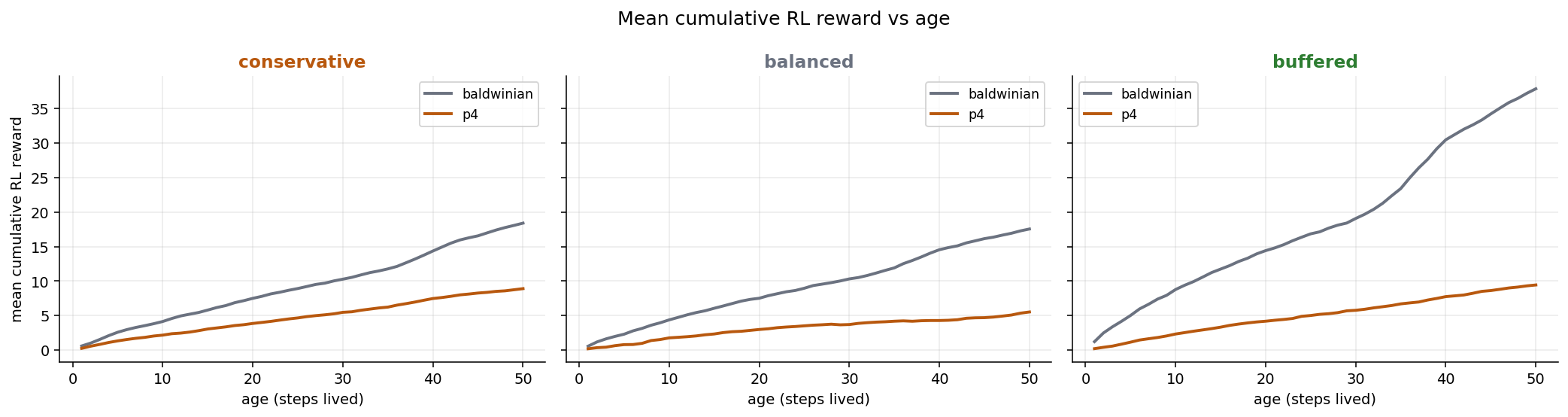
Cold-start (baldwinian) offspring track the ecology: they earn ~18 net
reward by age 50 in conservative/balanced and ~38 in buffered, because a
richer resource profile is worth more to an agent that can exploit it. The
warm-started offspring collapse into the same low band (~9) in all three
profiles — the environment gets richer and the warm-started child cannot cash
in. It is behaving to a parent-derived operating point that is blind to the
ecology it was actually born into.
That is why the harm is largest exactly where the opportunity is largest
(buffered): warm-start throws away the most reward precisely where cold-start
offspring gain the most. The loss is also reward-specific — survival barely
moves and the positive-action fraction is flat (a single tiny robust shift,
+0.034 for lamarckian/buffered). Warm-started offspring don’t die more; they
just forage worse.
Dose-response: more payload, more harm
The arms form a rough ladder of “how much of the parent is imposed on the
child,” and the damage grows with it. P4 — the richest payload (weight blend +
optimizer state + replay + fitness gate) — is the worst arm nearly everywhere,
robustly negative even on conservative and balanced where P1-P3 are only
null. P3 (optimizer + replay) is usually the mildest; P1/P2 sit in between.
This is the key point for interpreting the result: if the problem were “we didn’t transfer enough learned signal,” transferring more would help. It does the opposite, monotonically. The mechanism is not insufficient — it is maladaptive in this regime.
Is this a design issue or a hard barrier?
Both, and they are separable — and the separation is now closed.
It is a real barrier for this design. Across 90 runs / 3 profiles / 6 seeds, with warm-start firing on 96-100% of reproduction events (P4 gate hit-rate ~0.995), not one arm/profile/age tips robustly positive. A mechanism that merely needed tuning would usually win somewhere. The complete absence of upside, plus the dose-response, says that transplanting a parent policy into offspring is net-harmful here and you cannot tune your way out by enriching the payload.
The regime was confounded, so this post alone was not yet a fundamental verdict. Every arm ran at full saturation (final population 32/32 in essentially every cell). The +15-30 “honest budget” the whole program is graded against was measured by the gate in a sparse, fixed-8, no-reproduction regime. Offspring here are born into maximal crowding, where a parent policy tuned to different conditions is most likely to be wrong — which is exactly the clamping we see.
That confound is settled in the
07-09 low-churn follow-up:
the identical A/B with --low-churn (max_population = 8) still loses on
every cell. Saturation inflated absolute reward gaps; it did not create the
ranking. The barrier holds in both regimes.
What it means for #904
Under the decision rule — keep a richer payload only if it robustly beats P0 on early-life net reward without degrading stability — none of P1-P4 advance. Baldwinian cold-start stays the default. Richer payloads don’t help and usually hurt, worst of all in resource-rich ecologies.
Together with the low-churn follow-up, the honest claim is: Lamarckian-style policy inheritance does not beat Baldwinian cold-start on early-life reward in either the saturated or the sparse learning-positive regime, and richer payloads make it worse.
Reproduce
Full sweep (resume-safe; skips completed cells):
PYTHONHASHSEED=0 python scripts/run_inheritance_mode_ab.py \
  --arms baldwinian lamarckian p2 p3 p4 \
  --population 8 --max-population 32 \
  --num-steps 3000 --snapshot-interval 100 \
  --warmstart-replay-buffer-limit 256 \
  --output-dir experiments/inheritance_ab_learning_positive \
  --disk-database --resume
Grade it (primary #904 verdict + whole-population comparison):
python scripts/analyze_early_life_fitness.py \
  --ab-dir experiments/inheritance_ab_learning_positive \
  --baseline-arm baldwinian --treatment-arms lamarckian p2 p3 p4

python scripts/compare_inheritance_arms.py \
  --baseline-dir experiments/inheritance_ab_learning_positive/baldwinian \
  --baseline-label baldwinian \
  --treatment-dir experiments/inheritance_ab_learning_positive/lamarckian \
  --treatment-dir experiments/inheritance_ab_learning_positive/p2 \
  --treatment-dir experiments/inheritance_ab_learning_positive/p3 \
  --treatment-dir experiments/inheritance_ab_learning_positive/p4 \
  --arm-labels lamarckian p2 p3 p4 \
  --output-dir experiments/inheritance_ab_learning_positive/aggregate
Outputs land in experiments/inheritance_ab_learning_positive/early_life/
(early_life_ladder_summary.json / .md) and .../aggregate/.
Open questions
- Is saturation the killer? Settled — no. See Sparse ecology doesn’t save the ladder.
- Does the clamp relax with a weaker blend? P4 at blend 0.5 imposes half the
parent policy; sweeping the blend toward 0 should interpolate back to P0. If
even a small blend hurts in
buffered, the imposition itself is the problem. - Per-offspring warm-start contrast. Coverage is ~100%, so the arm-level
comparison can’t separate “warm-started” from “born via the treatment path.”
Per-offspring applied/skipped telemetry would let us compare warm-started and
cold offspring within the same run (see the
incompatible_stateskip issue). - Different transfer designs. Distilled priors, delayed fitness-gated transfer, or partial-layer warm-start are untested; the barrier is for this warm-start-on-reproduction ladder.
Related docs
- Sparse ecology doesn’t save the ladder: warm-start still loses
- Implement inherited-payload ladder (P2-P4) and run the #848 experiment (#904)
- Pilot early-life results: no RL-reward gain vs P0 (#964)
- The transferable-signal gate: do learned policies beat their own init?
- Baldwinian vs Lamarckian: policy warm-start across three resource regimes
- Are we measuring at the wrong level?
- Inherited payload design