
Does selection pressure purge maladaptive goals?
When every agent optimizes an independently sampled reward function, the population carries fewer agents and its behavior collapses toward gathering. That raises the question tracked as #892:
Does the strength of selection decide whether maladaptive/random objectives get purged? Stronger selection should shrink goal diversity over time (favoring near-baseline objectives) and ease the population suppression; weaker selection should let diversity persist or grow with suppression at least as severe.
Short answer: the unique-goals population is robustly suppressed at every
pressure, and it does not purge the diverse objectives — goal diversity
ends near its starting value even under a per-gene, span-normalized metric, and
the gather shift is flat at ~+17 pp. The unique − uniform gap does shrink
from low to high, but read the mechanism carefully: the gap narrows because
the denser control arm loses more under a density-dependent cost, not
because the random-goal population recovers (see below). Moreover, the shared
arm shows the suppression is mostly not about diversity at all: ~85% of it
is reproduced by giving every agent the same random goal, so the cost is
being off the tuned default, while goal heterogeneity per se costs only ~4–6
agents of mean population and is not statistically significant. So pressure
changes how heavily the population pays for un-curated objectives, not
which objectives persist — and most of that payment is the mean shift, not
the diversity.
The manipulation
The experiment
(farm/runners/intrinsic_goals_experiment.py)
runs three arms with identical seeds and configuration so the only difference
is the agents’ objectives:
uniform(control) — every agent shares the default reward function.shared(homogeneous, off-default) — one reward function is sampled per replicate and given to every agent, so the population objective is uniform but shifted off the tuned default.unique(heterogeneous) — every initial agent gets an independently sampled reward function (eachreward_*gene drawn uniformly within its bounds); offspring inherit and mutate their parent’s goal.
The shared arm is what makes the design a decomposition rather than a single
comparison. “Random goals” bundles two things: goals being heterogeneous and
the population-mean objective being shifted off the hand-tuned default — the
default sits near the low end of most gene ranges, so a uniform draw weights
resources ~10× more on average. The three arms pull those apart:
shared − uniform is the mean shift off the tuned default,
unique − shared is pure goal heterogeneity, and unique − uniform is the
total. Platform-wide
initial diversity is turned off in every arm, so learning hyperparameters and
action priors stay at their defaults and only the goal genes differ. Selection
pressure is a density-dependent reproduction cost: low barely penalizes
crowding, high penalizes it steeply, so a maladaptive goal that wastes
actions is punished harder at higher pressure.
Setup
20 paired replicates, 600 steps per arm, base seed 42, per pressure level. Each
replicate uses a distinct seed shared by all three arms, so every pairwise
contrast is paired and the only manipulated variables are the objective and
the pressure level. The population cap is set to 3000 so density-dependent
selection — not a hard headcount ceiling — governs the dynamics. Ran on a GCP
Spot n2-standard-8.
source venv/bin/activate
python scripts/run_intrinsic_goals_pressure_sweep.py \
    --pressures low medium high \
    --num-steps 600 --seed 42 --num-replicates 20 \
    --max-population 3000 --output-dir experiments
python scripts/analyze_intrinsic_goals_pressure_sweep.py --sweep-dir experiments
Deltas are paired per seed, reported with a 95% CI and Cohen’s dz. The
population/behavior tables below are the unique − uniform total; the
shared-arm decomposition (shared − uniform, unique − shared) is in the
“Separating heterogeneity from the mean shift” section. Source artifacts:
gcp-results-3arm/combined_comparison.*.
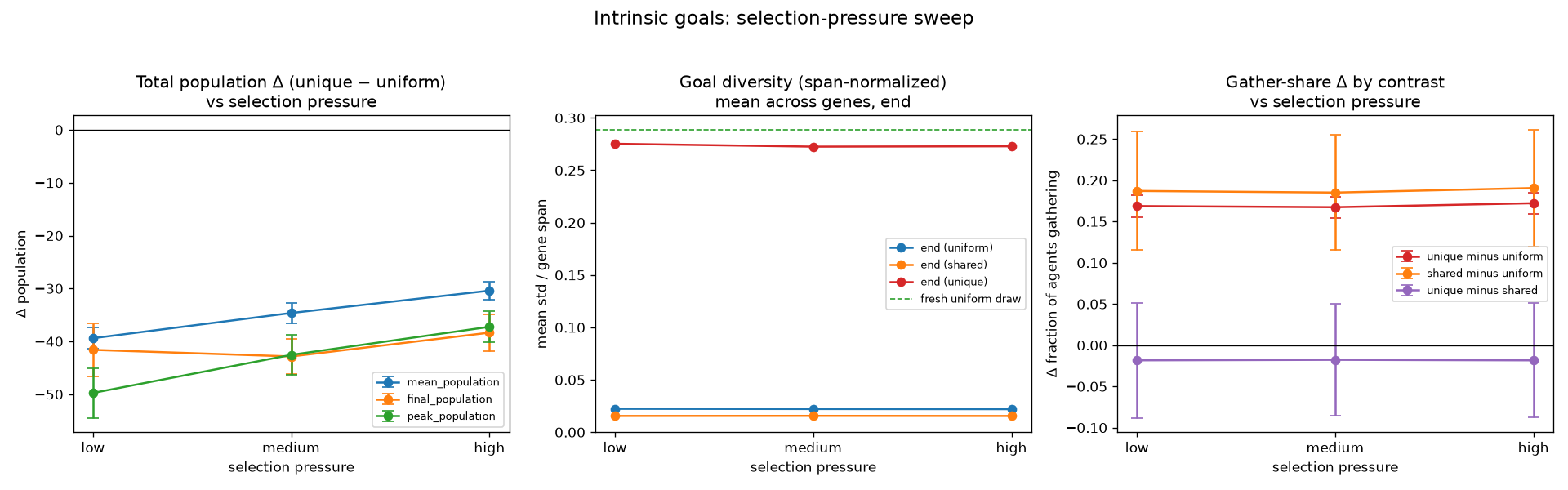
Population suppression eases with pressure
Paired unique − uniform deltas (mean [95% CI], dz). * marks p < 0.05.
| Metric | low | medium | high |
|---|---|---|---|
| mean population | −39.40* [−41.42, −37.38] (dz=−9.13) | −34.63* [−36.55, −32.70] (dz=−8.42) | −30.41* [−32.16, −28.66] (dz=−8.12) |
| final population | −41.60* [−46.58, −36.62] (dz=−3.91) | −42.85* [−46.09, −39.61] (dz=−6.18) | −38.35* [−41.79, −34.91] (dz=−5.22) |
| peak population | −49.75* [−54.45, −45.05] (dz=−4.95) | −42.55* [−46.26, −38.84] (dz=−5.36) | −37.25* [−40.18, −34.32] (dz=−5.95) |
| total births | −110.65* [−126.59, −94.71] (dz=−3.25) | −90.35* [−101.49, −79.21] (dz=−3.80) | −61.85* [−71.44, −52.26] (dz=−3.02) |
| total deaths | −69.05* [−83.01, −55.09] (dz=−2.31) | −47.50* [−59.80, −35.20] (dz=−1.81) | −23.50* [−32.80, −14.20] (dz=−1.18) |
| gather-share Δ | +0.17* [0.16, 0.18] (dz=5.84) | +0.17* [0.15, 0.18] (dz=6.06) | +0.17* [0.16, 0.18] (dz=6.36) |
Absolute levels for context (mean / peak population):
| Arm | low | medium | high |
|---|---|---|---|
| uniform | 95.3 / 152.3 | 88.4 / 142.3 | 81.9 / 129.2 |
| shared | 62.3 / 108.7 | 58.8 / 100.7 | 56.0 / 96.5 |
| unique | 55.9 / 102.6 | 53.8 / 99.8 | 51.5 / 91.9 |
The unique arm is suppressed at every pressure — fewer agents, lower peak, and fewer births — and the size of that gap shrinks as selection gets stronger: mean-population Δ narrows from −39.4 to −30.4, peak Δ from −49.8 to −37.2, births Δ from −110.7 to −61.9, and deaths Δ from −69.1 to −23.5. Final population is the exception — it stays around −40 across all three levels.
But the mechanism is not what the hypothesis assumed. The gap does not narrow because the random-goal population recovers — in absolute terms it also declines with pressure (mean 55.9 → 53.8 → 51.5). It narrows because the control declines faster (95.3 → 88.4 → 81.9). The entire −9.0 change in the mean-population gap (−39.4 → −30.4) is the control falling 13.4 while the treatment falls only 4.4. That is close to mechanical: the reproduction cost is density-dependent, and the control runs at ~1.7× the treatment’s density, so it is hit harder by the crowding penalty regardless of goal composition. Framed as a fraction of the control, the unique arm rises only modestly, from 58.7% to 62.9%. So “stronger selection eases the suppression” is better stated as “stronger density-dependent pressure compresses the denser control toward the sparser treatment.”
Separating heterogeneity from the mean shift
The shared arm splits the total into two paired contrasts. shared − uniform
is the cost of the population’s average objective sitting off the tuned
default; unique − shared is what goal diversity adds on top of that.
shared − uniform (mean shift):
| Metric | low | medium | high |
|---|---|---|---|
| mean population | −33.04* [−42.43, −23.65] (dz=−1.65) | −29.58* [−37.88, −21.28] (dz=−1.67) | −25.93* [−33.36, −18.50] (dz=−1.63) |
| final population | −35.85* [−48.30, −23.40] (dz=−1.35) | −34.75* [−46.64, −22.86] (dz=−1.37) | −32.15* [−41.62, −22.68] (dz=−1.59) |
| peak population | −43.65* [−57.50, −29.80] (dz=−1.48) | −41.65* [−54.54, −28.76] (dz=−1.51) | −32.60* [−43.20, −22.00] (dz=−1.44) |
| gather-share Δ | +0.19* [0.12, 0.26] (dz=1.22) | +0.19* [0.12, 0.25] (dz=1.24) | +0.19* [0.12, 0.26] (dz=1.26) |
unique − shared (pure heterogeneity):
| Metric | low | medium | high |
|---|---|---|---|
| mean population | −6.36 [−15.66, 2.93] (dz=−0.32) | −5.05 [−13.29, 3.20] (dz=−0.29) | −4.48 [−11.91, 2.94] (dz=−0.28) |
| final population | −5.75 [−18.20, 6.70] (dz=−0.22) | −8.10 [−18.20, 2.00] (dz=−0.38) | −6.20 [−14.90, 2.50] (dz=−0.33) |
| peak population | −6.10 [−19.70, 7.50] (dz=−0.21) | −0.90 [−13.65, 11.85] (dz=−0.03) | −4.65 [−15.33, 6.03] (dz=−0.20) |
| gather-share Δ | −0.02 [−0.09, 0.05] (dz=−0.12) | −0.02 [−0.09, 0.05] (dz=−0.12) | −0.02 [−0.09, 0.05] (dz=−0.12) |
The split is lopsided. The mean shift alone reproduces ~84–85% of the total suppression (−33.0 of −39.4 at low, −25.9 of −30.4 at high) and is significant on mean, peak, and final population at every pressure. Pure heterogeneity adds only −4 to −6 agents and is not significant anywhere — every CI crosses zero. The behavioral shift decomposes the same way: the whole ~+17 pp gather shift is carried by the mean shift (+19 pp, significant), while heterogeneity contributes −2 pp of noise. The pressure trend also lives in the mean-shift component (−33.0 → −25.9 from low to high), consistent with the density-compression reading above.
Two caveats on reading the shared contrasts. First, their dz values (~−1.5)
are much smaller than the total’s (~−9) even though the mean deltas are
similar: each shared replicate stakes everything on one random draw, so
between-replicate variance is large by design, whereas the unique arm
averages over ~30 independent draws per replicate. Second, for the same
reason, shared − uniform estimates the average cost of a random goal —
individual draws range from nearly harmless to catastrophic.
Do diverse goals get purged?
The obvious metric — the summed population std across all reward_* genes —
is misleading here: reward_death_penalty spans [0, 50], so its std alone
(~14 of ~18) is ~80% of the sum, and the number is blind to purging in the
other eight genes. Instead, each gene’s std is normalized by its range before
combining, so a fresh uniform draw sits near 1/√12 ≈ 0.29 for every gene
and per-gene collapse becomes visible.
Span-normalized diversity (mean std / gene span), unique arm, start vs end:
| Phase | low | medium | high |
|---|---|---|---|
| start (unique) | 0.28 | 0.28 | 0.28 |
| end (unique) | 0.28 | 0.27 | 0.27 |
| end (uniform, drift only) | 0.02 | 0.02 | 0.02 |
Per-gene end values (unique arm) confirm nothing is singled out — every gene holds near its ~0.29 starting spread at every pressure:
| Gene | start | end (low) | end (medium) | end (high) |
|---|---|---|---|---|
| resource_weight | 0.28 | 0.26 | 0.27 | 0.26 |
| health_weight | 0.29 | 0.28 | 0.27 | 0.27 |
| survival_weight | 0.28 | 0.29 | 0.28 | 0.28 |
| death_penalty | 0.29 | 0.28 | 0.27 | 0.28 |
| action_bonus | 0.28 | 0.27 | 0.27 | 0.26 |
| gather_bonus | 0.28 | 0.27 | 0.27 | 0.28 |
| share_bonus | 0.28 | 0.27 | 0.27 | 0.27 |
| attack_bonus | 0.28 | 0.28 | 0.28 | 0.29 |
| reproduce_bonus | 0.28 | 0.27 | 0.27 | 0.27 |
So the “no purge” reading survives the better metric: high pressure does not drive any gene’s diversity toward 0, and the objectives coexist for the full horizon. The important caveat is the horizon itself — at 600 steps the unique arm turns over only ~3 generations (~160–190 births at a mean population of ~55), which is very little opportunity for selection to purge standing variance, so this is evidence of slow purging at most, not of selection being unable to purge (#893).
Behavior is pressure-invariant too: unique agents spend ~47–48% of actions
gathering versus ~30–31% in the control, a ~+17 pp shift that is essentially
identical at low, medium, and high (dz ≈ 6 throughout). This is the direction
a mean shift predicts — a uniform draw weights resources ~10× the default —
and the shared arm confirms it: a single random goal produces the same +19 pp
gather shift with no additional contribution from heterogeneity.
Conclusion
The answer to #892 is a qualified yes on suppression, no on purging — with the twist that the suppression is mostly not about diversity:
- Suppression eases with pressure. The mean-, peak-, and birth/death gaps
all shrink monotonically from
lowtohigh— though the narrowing is the denser control being compressed, not the treatment recovering. - The cost is the mean shift, not the diversity. Giving every agent the same random goal reproduces ~85% of the suppression; heterogeneity on top of that costs −4 to −6 agents and is not significant at any pressure.
- Goals are not purged. Unique-arm span-normalized diversity ends at 0.27–0.28 (start 0.28) at every level, with no per-gene collapse — no monoculture, even at high pressure — and the gather shift is flat at +17 pp.
So selection pressure changes how heavily a population pays for un-curated objectives without changing which objectives persist — and what it pays for is chiefly being off the tuned default, not being diverse. A population of agents that disagree with each other about what matters does roughly as well as one that agrees on the same wrong thing.
Open questions / caveats
reward_death_penaltyis sampled on a [0, 50] range and dominates the reward magnitude, so much of the variation in the other eight genes may be behaviorally near-neutral. That would explain both halves of the heterogeneity result at once: goal diversity costs little and is not purged because selection cannot see most of it (#894).- The unique arm’s final population sits well below the control at every pressure; a longer horizon would show whether it plateaus, recovers, or dies out (#893).