
When every agent has a different goal
The reward function is the one thing every agent in AgentFarm has historically shared. Two agents could inherit different learning rates, different action priors, different everything — but they were all graded by the same yardstick: gain resources, keep health up, stay alive, do something each step. This post asks what happens when we take that last shared assumption away and let the objective itself be a per-agent, heritable trait.
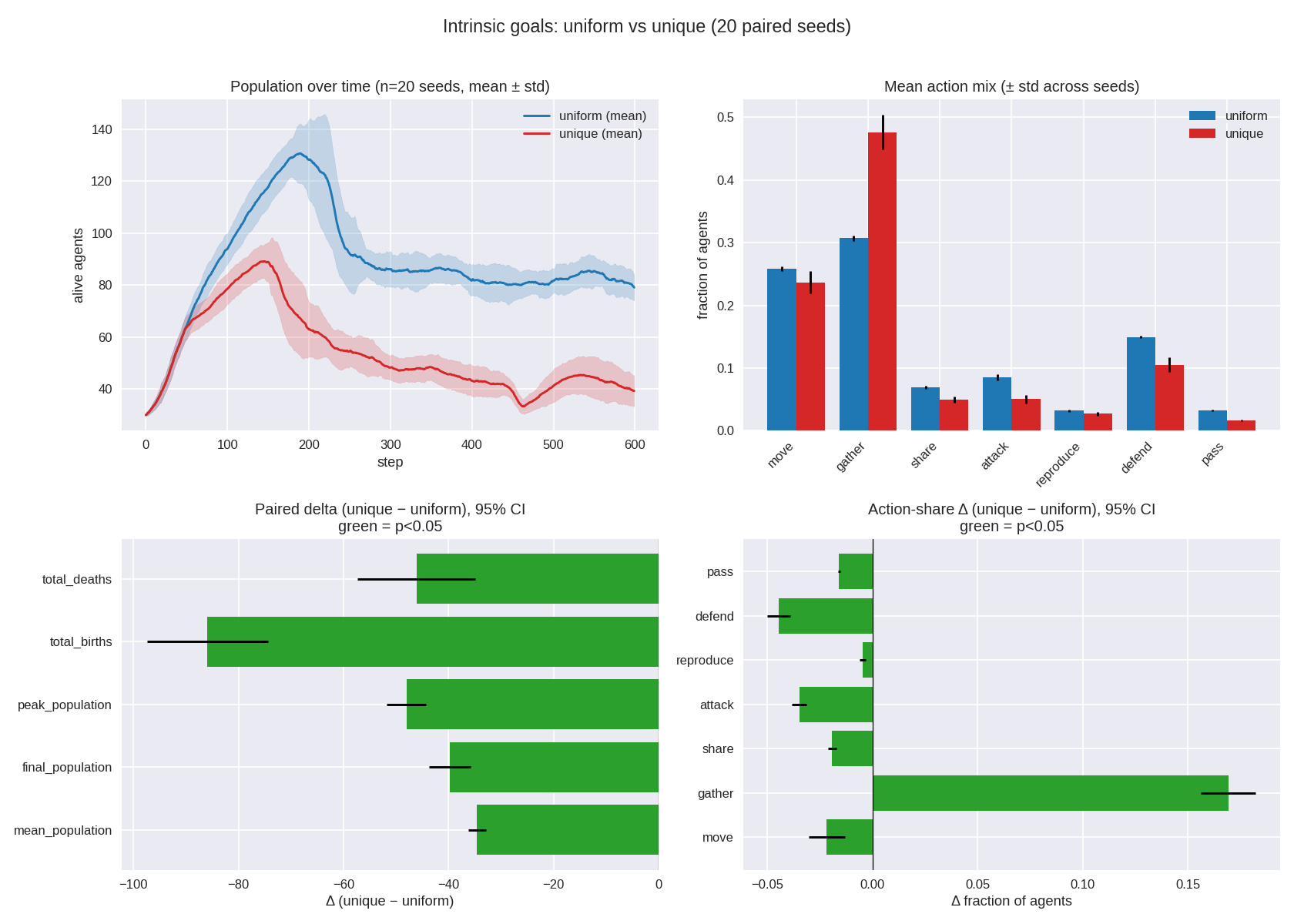
The short version: heterogeneous, randomly-drawn goals are not a wash and they are not a free lunch. Against a matched control, a population of agents that each optimize a different reward function carries ~40% fewer agents and collapses its behavior toward gathering. The effect is enormous and dead consistent across 20 paired seeds.
The manipulation
Each agent’s per-step reward is computed in AgentCore._calculate_reward, which
now reads a block of Chromosome C goal genes (the reward_* loci in
farm/core/hyperparameter_chromosome.py):
| Gene | Default | Range | Meaning |
|---|---|---|---|
reward_resource_weight |
0.1 | [0, 2] | value of net resource gain |
reward_health_weight |
0.5 | [0, 2] | value of net health gain |
reward_survival_weight |
0.1 | [0, 1] | per-step bonus for staying alive |
reward_death_penalty |
10.0 | [0, 50] | penalty applied on death |
reward_action_bonus |
0.05 | [0, 1] | bonus for any non-pass action |
reward_gather_bonus |
0.0 | [0, 2] | intrinsic bonus for gathering |
reward_share_bonus |
0.0 | [0, 2] | intrinsic bonus for sharing |
reward_attack_bonus |
0.0 | [0, 2] | intrinsic bonus for attacking |
reward_reproduce_bonus |
0.0 | [0, 2] | intrinsic bonus for reproducing |
These are ordinary genes: heritable, mutated on reproduction, selected implicitly (a self-defeating goal kills its carrier and dies out), and logged automatically by the gene-trajectory and speciation tooling. The default chromosome reproduces the historical reward formula exactly, so the control arm is the world as it always was.
The experiment (farm/runners/intrinsic_goals_experiment.py) runs two arms with
identical seeds and configuration — the only difference is the agents’
objectives:
uniform(control) — every agent shares the default reward function.unique(treatment) — every initial agent gets an independently sampled reward function (eachreward_*gene drawn uniformly within its bounds); offspring inherit and mutate their parent’s goal.
Platform-wide initial diversity is turned off in both arms, so learning hyperparameters and action priors stay at their defaults and only the goal genes differ.
Setup
20 paired replicates, 600 steps per arm, medium selection pressure. Each replicate uses a distinct seed for both arms, so every comparison is paired and the only manipulated variable is the objective.
source venv/bin/activate
python scripts/run_intrinsic_goals_experiment.py \
    --num-steps 600 --seed 42 --num-replicates 20 \
    --selection-pressure medium \
    --output-dir experiments/intrinsic_goals_comprehensive
All deltas below are paired (unique − uniform) per seed, reported with a 95%
CI and Cohen’s dz; every one clears p < 0.05 by a wide margin.
The manipulation took, and it stuck
The treatment population stays genuinely diverse for the whole run. Summed goal-gene diversity (std across the population) ends at 17.58 in the unique arm versus 1.52 in the control (Δ +16.06, dz = 7.88). Selection over 600 steps did not grind the diverse objectives back down to a monoculture — multiple goals coexist all the way to the end.
Diverse goals suppress the population
| Metric | uniform | unique | Δ (paired) | Cohen’s dz |
|---|---|---|---|---|
| mean population | 88.2 | 53.7 | −34.5 | −9.88 |
| final population | 79.1 | 39.3 | −39.8 | −4.71 |
| peak population | 142.5 | 94.5 | −48.0 | −5.99 |
| total births | 227.0 | 141.1 | −85.9 | −3.50 |
| total deaths | 177.9 | 131.8 | −46.1 | −1.92 |
The population panel tells the story: the control climbs to ~130 around step 180 and then settles near 80, while the unique arm peaks lower (~90) and then declines steadily, still trending down at step 600. Fewer births (−86) dominate fewer deaths (−46), so the net effect is a smaller population at a lower carrying capacity. Random objectives are, on average, maladaptive relative to the hand-tuned baseline.
Behavior collapses toward gathering
| Action | Δ share (unique − uniform) | Cohen’s dz |
|---|---|---|
| gather | +16.9 pp | +6.08 |
| reproduce | −0.5 pp | −1.59 |
| pass | −1.6 pp | −12.73 |
| share | −1.9 pp | −4.55 |
| move | −2.2 pp | −1.16 |
| attack | −3.5 pp | −4.64 |
| defend | −4.4 pp | −3.80 |
Unique-goal agents spend ~48% of their actions gathering versus ~31% in the control, and everything else drops. The behavioral signature of “everyone wants something different” turns out to be “almost everyone over-invests in resource gathering” — consistent with the lower birth rate and the shrinking population.
How to read this
This is random heterogeneous goals vs. one hand-tuned goal — not “diversity good” vs. “diversity bad” in the abstract. The control is a strong, optimized baseline, so the cleanest reading is that un-curated objective diversity lowers collective fitness: when each agent is graded by an arbitrary yardstick, most yardsticks are worse than the one we tuned, and the population pays for it in births and headcount.
One structural caveat worth flagging up front: reward_death_penalty is sampled
on a [0, 50] range and lands ~20× larger than every other gene (population mean
~24, population std ~13.7), and it barely moves over the run. So a large share of the “diversity”
effect may really be that single high-magnitude gene dominating the reward scale
rather than genuine multi-objective heterogeneity. Disentangling that is a
follow-up, not a conclusion.
Is the result solid?
Yes. With 20 paired seeds every headline metric is significant at p < 0.05 — most at p ≪ 1e-12 — with effect sizes from dz ≈ 1.6 up to ≈ 12.7 (0.8 is already “large”). The confidence intervals are tight and nowhere near zero. The question now is not whether diverse goals matter but which goals are adaptive and why the population shrinks.
Open questions
- Does selection ever purge bad goals? At medium pressure diversity persisted. A low/medium/high sweep would show whether stronger selection collapses the diverse objectives and eases the suppression (#892).
- Stabilize or go extinct? The unique arm is still declining at step 600. A longer horizon (≥1500 steps) would reveal whether it plateaus, recovers, or dies out (#893).
- Is
reward_death_penaltythe whole story? Ablating / rescaling that one high-magnitude gene would isolate how much of the effect is genuinely multi-objective (#894). - Which objectives are adaptive? Correlating each agent’s reward genes with its lifespan and lineage size would map the selection gradient on every gene (#895).